Meet Bernard: The Designer Who Knows When Process Isn’t Enough
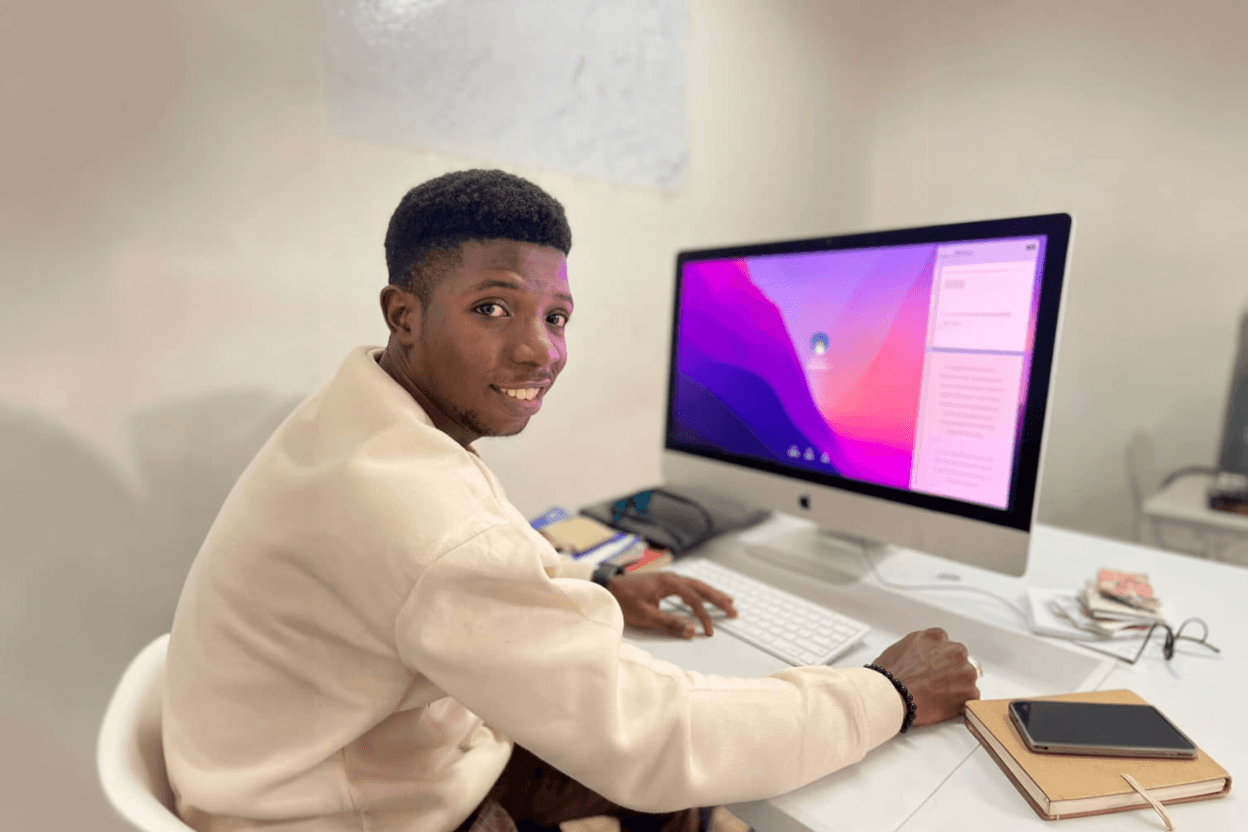

Foncham Bernard studied petroleum engineering.
Not design. Not computer science. Petroleum engineering. Two degrees in it. And somewhere in the middle of learning how oil moves through the earth, he discovered something that changed the direction of everything.
Design made him feel something engineering never did.
He doesn't overcomplicate the explanation. Creating things, expressing ideas visually, and watching something take shape from nothing spiked his dopamine levels. That's how he puts it. And once he felt that, the path forward stopped being a question.
Nobody hands you a roadmap for that kind of pivot. You just follow what lights you up and figure out the rest as you go.
Coffee First, for a productive day
Bernard's mornings have a rhythm to them.,Gets in on Slack then a quick scan of what the day actually needs, and then coffee. Only then does he open Figma.
That sequence matters to him. Not as a ritual, but as a way of showing up prepared instead of reactive. Creative work has a way of pulling you in six directions before you've had a chance to think clearly. Bernard doesn't let it. He decides what the day needs before the day decides for him.
From there it's heads down. Wireframes, prototypes, website designs, slide decks, whatever the brief demands. Before he logs off, he circles back with the team. Updates shared, questions answered, day closed properly.
That kind of intentional structure is what lets him do his best work without burning out. Two engineering degrees, freelance jobs, self-taught from scratch, when nobody hands you the path, you learn fast what happens when you lose your footing.
He started on Canva, which is either a humble beginning or a brave one, depending on who you ask. Either way, he was moving. From Canva, he went to Iknite Studio . Trainee, then intern, then full designer. By the time he joined Camsol, he had a real process. What he was still discovering was when to trust it and when to let it go.
Sometimes You Have to Set It Down
That lesson came from a rock band.
At Camsol, Bernard was handed a brief for Mondpalast. A dark, specific, uncompromising rock band that needed a full visual world built around them. Mood boards, color palettes, style guides, album covers, billboards, social media. Everything.
His process couldn't help him here. You can't organize your way into understanding a rock band's soul. Mon Palace had an energy, a personality, a feeling they wanted people to have the moment they laid eyes on anything connected to them. Bernard had to find that feeling before he could translate it into anything visual.
So he went deep. He sat with their music. He studied their influences. He stayed with it until something clicked and he understood not just what they looked like but what they meant. Only then did he start designing.
The result felt like Mon Palace. Not a designer's interpretation of a rock band. The actual band. Raw where it needed to be, controlled where it helped, consistent all the way through without losing the edge that made them distinct.
What that project gave him wasn't just a strong portfolio piece. It gave him a better instinct for when to pause. Some briefs need your process. Some need you to put the process down and just listen. Knowing which is which is something you can't learn in a classroom. You learn it by getting it wrong once, and then getting it right.
He carried that instinct into Camsol. It shows in how he reads a brief before a meeting starts. It shows in the questions he asks. It shows in the work.
He Shows Up Prepared
Bernard is not the loudest voice in a room. He is usually the one who has already done the reading.
His questions cut to the point and he doesn’t have to show how hard he is working. He just arrives having done the work, which is a different and quieter kind of confidence.
At Camsol, that showed up beyond design work too. He took on product management, leading two B2B SaaS platforms from concept to launch, keeping design, engineering, and marketing moving in the same direction. For a self-taught designer who started on Canva, that kind of responsibility is not a small distance to travel.
Professionally, he follows Kingsley Orji, a senior UX designer based in the UK. Not to admire the portfolio but to study the approach. How he breaks down a problem before touching any tools. How he builds prototypes that think before they look good. For Bernard, watching someone further ahead and extracting the method is how he keeps getting better.
What keeps him at Camsol is the openness. Ideas get shared. Growth is part of the culture. For someone who built everything outside a traditional path, an environment that invests in people is not something he takes lightly.
After the Wireframes
Away from the desk, Bernard lets the structure go.
He plays football with the kind of passion that doesn't need explaining if you grew up in Cameroon. Ninety minutes where nothing needs organizing. Just the ball and whatever happens next.
When he travels, he doesn't appear to have a plan. New cities, unfamiliar places, different rhythms. The man who checks Slack before opening Figma apparently has no problem wandering somewhere he has never been without an itinerary.
And after all of it, the wireframes, the football, the long weeks, he comes home to water-fufu and eru. Slow-cooked, richly spiced eru with smooth water fufu. No occasion needed. Just a good reason to finally sit down.
Turns out the most organized person in the room just needs the right excuse to forget the list entirely.
Bernard doesn't talk much about the journey from petroleum engineering to design. He just shows up, does the research, and lets the work explain it.
So far, it's explaining itself pretty well.